You listed your Dubai apartment on Airbnb. You furnished it beautifully. You wrote the perfect description with golden hour photos. You set competitive pricing. And for the first few months, bookings were steady, and reviews were glowing.
Then something shifted.
A 3-star review appeared. Then another. Words like “chipped tile,” “peeling paint near the balcony,” and “bathroom grout looks dirty” started showing up. Not major complaints. Not anything that would make a normal tenant pack up and leave. But on Airbnb’s algorithm, these micro-complaints are lethal. They quietly push your listing down in search results, increase your vacancy rate, and chip away at your SuperHost status — all while you wonder what went wrong.
The answer, in most cases, is building maintenance. Not the dramatic kind — a burst pipe or a broken AC. The slow, invisible kind that accumulates over months and only becomes visible when a guest photographs it and uploads the image to their review.
This guide is for Dubai hosts who want to stay competitive in a market that now has over 15,000 DTCM-licensed holiday home units. Because in this environment, a 4.6 star average doesn’t just mean slightly lower reviews — it means Airbnb actively suppresses your listing in favor of the 4.9-star property two floors above you.
Why Dubai Airbnb Properties Age Faster Than You Think
Residential apartments are designed for long-term tenants who treat the property as a home. They’re careful. They report problems. They have an incentive to maintain the space because they live there.
Holiday home guests are different. High turnover, luggage scraping walls, bathroom fixtures used daily by different people, the aggressive Dubai humidity accelerating wear on grout and paint — your property physically degrades faster than a standard rental. Most hosts don’t account for this in their maintenance calendar.
By the time a maintenance issue is visible to a guest, it has usually been developing for three to six months. That’s six months of photos being taken and uploaded. Six months of reviews mentioning it. Six months of Airbnb’s algorithm quietly noting that guests are unhappy with the condition.
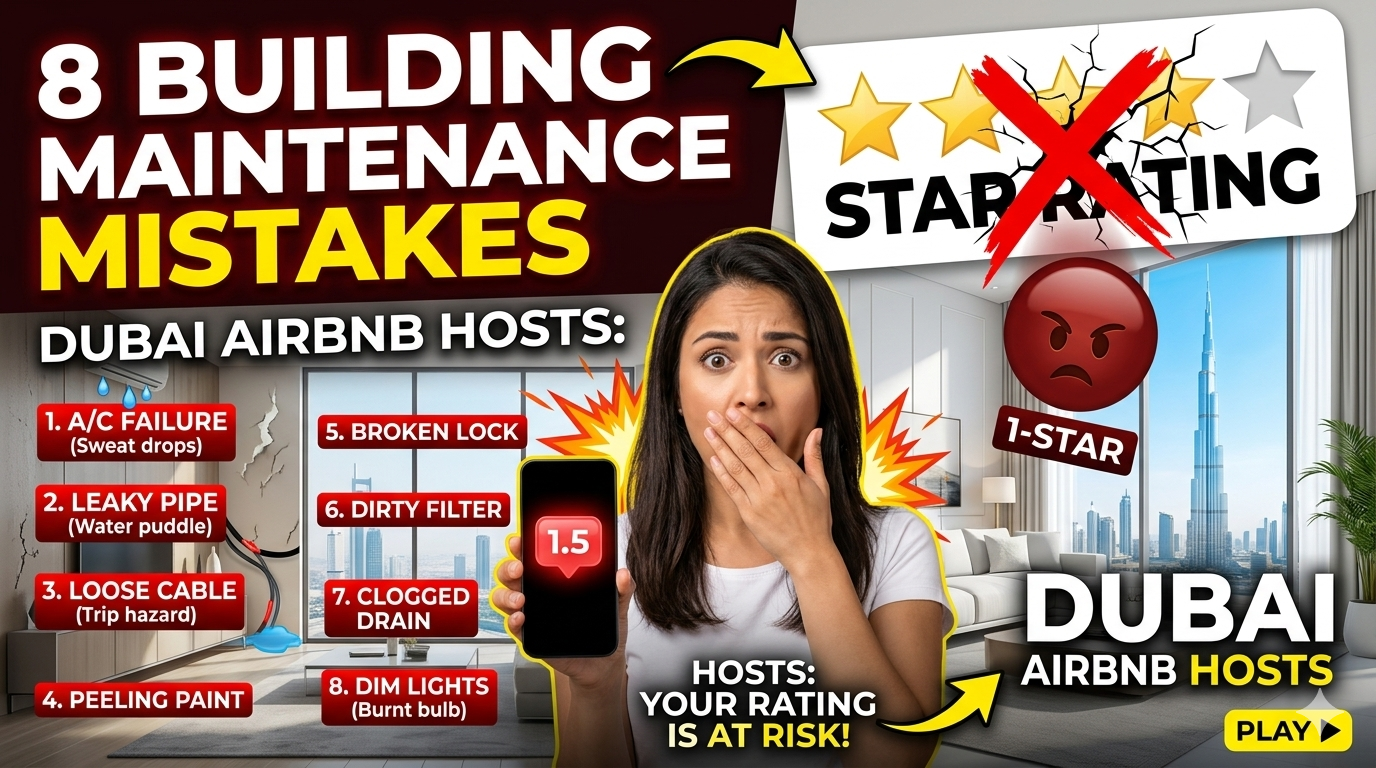
Here are the eight maintenance mistakes Dubai Airbnb hosts make most often, and exactly how to fix them before they damage your income.
Mistake 1: Treating Paint as a One-Time Job
Paint in a high-occupancy property is a consumable, not a permanent fixture. Guests brush luggage against walls, chairs scrape skirting boards, humidity in bathrooms causes bubbling near windows. In a long-term rental, minor paint scuffs are invisible because they accumulate slowly. In a holiday home with 12–18 different guests per month, those same scuffs appear within weeks.
The fix: Schedule a professional painting review every 8–10 months. Focus on high-touch areas — around door frames, behind beds, near light switches, and bathroom walls. A fresh coat of paint is one of the cheapest improvements you can make per room, and guests consistently rate “clean, well-maintained” spaces higher than “luxury but tired-looking” ones.
Mistake 2: Ignoring Grout Until It’s Discolored or Cracking
Bathroom grout is one of the most photographed areas in a negative Airbnb review. Guests notice it. They think it means the apartment is unhygienic, even if it isn’t. Cracked or discolored tile grout in bathrooms and kitchens signals that the property hasn’t been properly maintained — regardless of how clean everything else is.
Grout deteriorates from constant water exposure, cleaning chemicals, and temperature changes. In Dubai’s climate, this happens faster than in cooler regions. A professional re-grouting job costs a fraction of the revenue lost from a single month of suppressed booking visibility.
Mistake 3: Delaying Tile Repairs Because “It’s Just a Small Crack”
A chipped corner tile in the bathroom seems minor to you. To a guest who paid AED 600 per night, it photographs as evidence that the property isn’t worth what they paid. Loose tiles are also a safety hazard — if a tile comes up completely during a guest’s stay, you’re looking at liability, a negative review, and a potential refund request simultaneously.
The rule is simple: if you notice a cracked or loose tile during a property inspection, fix it before the next booking opens. Not after. Before.
Mistake 4: Not Having a Responsive Maintenance Contact
This one isn’t about physical maintenance — it’s about systems. Dubai’s short-term rental market is competitive enough that guests choose properties partly based on how quickly hosts respond to issues. If a guest reports a loose cabinet door, dripping tap, or broken shower rail and you can’t send someone within four hours, they’re already composing their review in their head.
Your maintenance contact needs to be able to reach the property within hours — not days. This is especially critical for hosts who manage their Dubai property remotely.
Mistake 5: Skipping the Between-Booking Walk-Through
Most hosts rely entirely on cleaning staff to flag maintenance issues. Cleaners are excellent at what they do, but their job is turnover — changing linen, cleaning surfaces, restocking supplies. They are not trained to notice that the wall behind the shower door has begun to bubble, that the sealant around the bathtub is starting to peel, or that the kitchen tile has a hairline crack developing.
A maintenance-specific walk-through every six to eight weeks — separate from the cleaning schedule — is the difference between catching problems at AED 200 and catching them at AED 2,000.
Mistake 6: Waiting for Guests to Report Before Fixing
By the time a guest reports a maintenance issue, it’s already in your review. Dubai guests in the AED 300–900/night bracket expect five-star hotel standards. They won’t call you about a cracked tile — they’ll photograph it and mention it when rating their stay. Proactive maintenance means you find it first. Reactive maintenance means your guests find it for you.
Mistake 7: Using One Contractor for Everything (and Getting Delayed for All of It)
Hosts who use a single general handyman for every job often find that their person is booked when they need emergency work done. A specialist building maintenance team that handles tiling, painting, and interior works under one roof eliminates the coordination problem and ensures faster turnaround between bookings.
Mistake 8: Not Budgeting Maintenance as a Business Expense
Dubai holiday home hosts who treat maintenance as an emergency fund expense rather than a planned operational cost always end up spending more. Waiting for problems to become critical means bigger jobs, longer disruption, and more nights lost to vacancy during repairs.
Budget 8–12% of your annual rental income toward property maintenance. For a well-maintained apartment generating AED 120,000/year, that’s AED 10,000–14,400 annually — a small number compared to the revenue protection it buys.
The Competitive Reality in 2026
Dubai’s short-term rental market is maturing. The gap between well-maintained and poorly-maintained properties has never been more visible in search rankings and pricing power. Guests have more choice, more review data to compare, and higher baseline expectations.
Many hosts now run their own direct booking websites to reduce commission dependency on platforms like Airbnb. If you’re building that presence, getting your site indexed and discoverable starts with the basics — a properly structured sitemap submitted to Google is step one, and tools like mysitemaps make it straightforward even if you’re not technical.
But before you worry about direct bookings, your Airbnb rating needs to be airtight. Because word-of-mouth in Dubai’s expat community travels fast. A 4.9-star property with consistent positive reviews about cleanliness and upkeep has a compounding advantage — better visibility, higher pricing power, and guests who rebook directly without needing a platform at all.
Your building maintenance is not a cost. It is your marketing budget in disguise.